
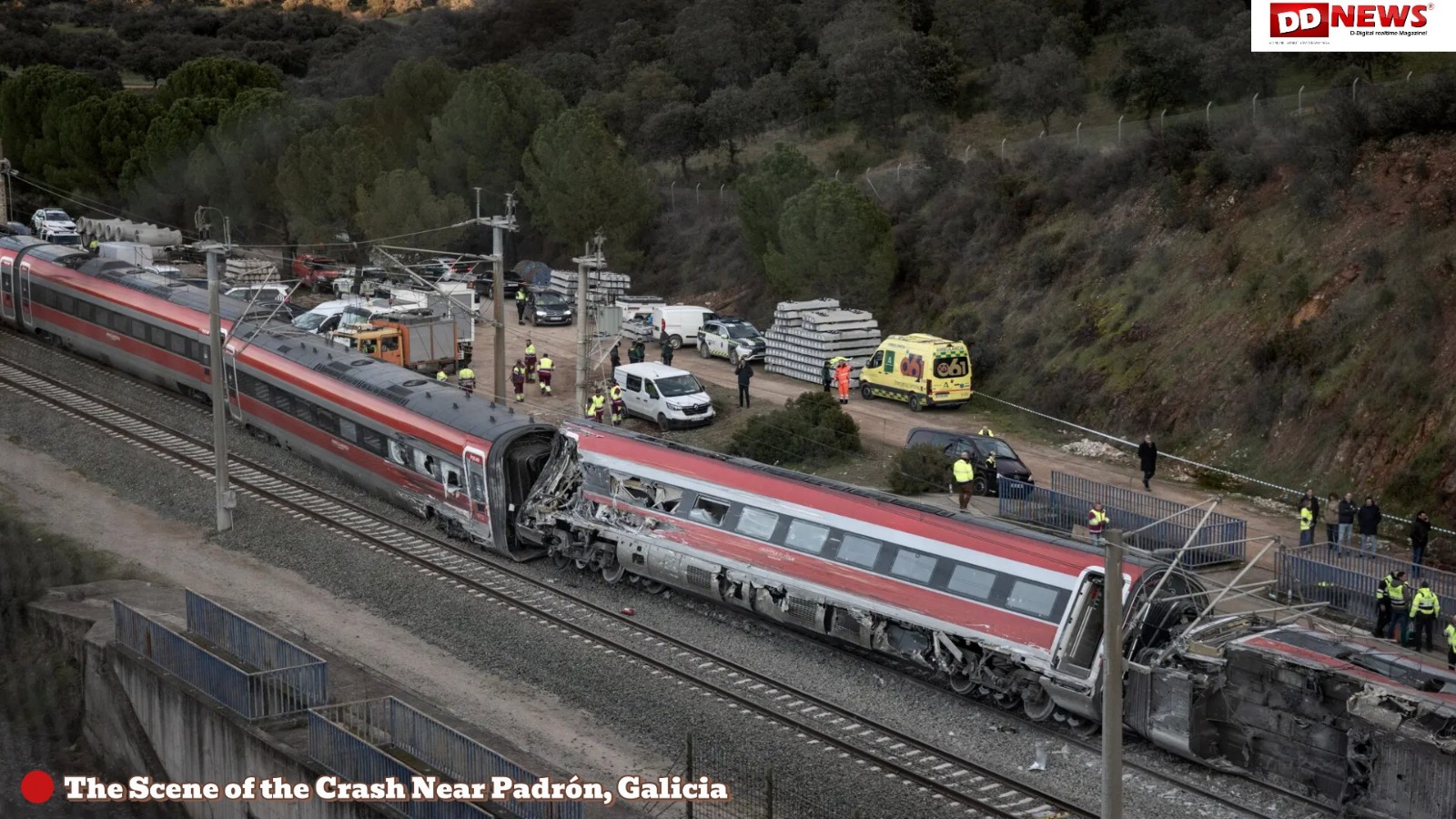
Spanish authorities continued on Tuesday, January 21, 2026, the painstaking process of identifying victims from Sunday’s catastrophic collision between two high-speed trains in Galicia that killed at least 41 people and injured more than 180 others.
The disaster occurred shortly before 9:00 a.m. local time when a Madrid-bound Alvia high-speed train collided head-on with a regional passenger train on the same track near the town of Padrón, approximately 20 km southwest of Santiago de Compostela.
Emergency services described the scene as “apocalyptic,” with the front carriages of both trains completely destroyed and debris scattered over hundreds of metres.
As of Tuesday evening, rescue teams had recovered all bodies, but forensic identification has proven extremely difficult due to the extreme force of the impact and subsequent fire. Dental records, DNA samples, and personal belongings are being used in a process expected to take several days.

Subscribe To The Best Team In Conservative, Business, Technology, Lifestyle And Digital News Realtime! support@ddnewsonline.com
Investigation Focuses on Track Switch Failure Investigators from Spain’s National Court and the Railway Accident Investigation Commission (CIAF) have zeroed in on a possible failure or incorrect positioning of a track switch (railroad switch/point) as the primary cause of the collision.
Initial findings indicate:
The high-speed train (Madrid → Santiago route) was incorrectly routed onto the same single track as the regional train heading in the opposite direction.
The automatic signalling and protection system (ASFA Digital) appears to have failed to prevent the head-on crash.
Speed data from the black box shows the Alvia train was travelling at approximately 180–200 km/h at the moment of impact—well above the safe speed for the section.
Spain’s Transport Minister Óscar Puente confirmed the track switch theory as the “main line of investigation” but stressed that no conclusions would be drawn until the full analysis of the event recorders and witness statements is complete.
Subscribe To The Best Team In Conservative, Business, Technology, Lifestyle And Digital News Realtime! support@ddnewsonline.com
National Mourning & Response King Felipe VI and Queen Letizia visited the site and injured survivors on Monday. Three days of national mourning have been declared, with flags at half-mast across the country.
Prime Minister Pedro Sánchez called it “one of the worst rail tragedies in recent Spanish history” and promised a thorough, independent investigation.
Victims and Survivors Among the confirmed dead are entire families, students, and commuters. At least 15 victims were from outside Galicia, including several foreign nationals (two from Portugal, one from France, and one from Colombia).
Over 90 people remain hospitalised, 22 in critical condition, mostly with severe burns, crush injuries, and head trauma.
By Ogungbayi Beedee Adeyemi
Send tips to: adeyemi@ddnewsonline.com | 08168555497
Backbiome is an advanced daily wellness supplement formulated to help support spinal comfort, reduce feelings of built-up tension, and promote freer, smoother movement throughout backbiome everyday life.