

By Ogungbayi Adeyemi S. | adeyemi@ddnewsonline.com
Editor, DDNews |
DDNewsOnline – Lagos, July 8, 2026
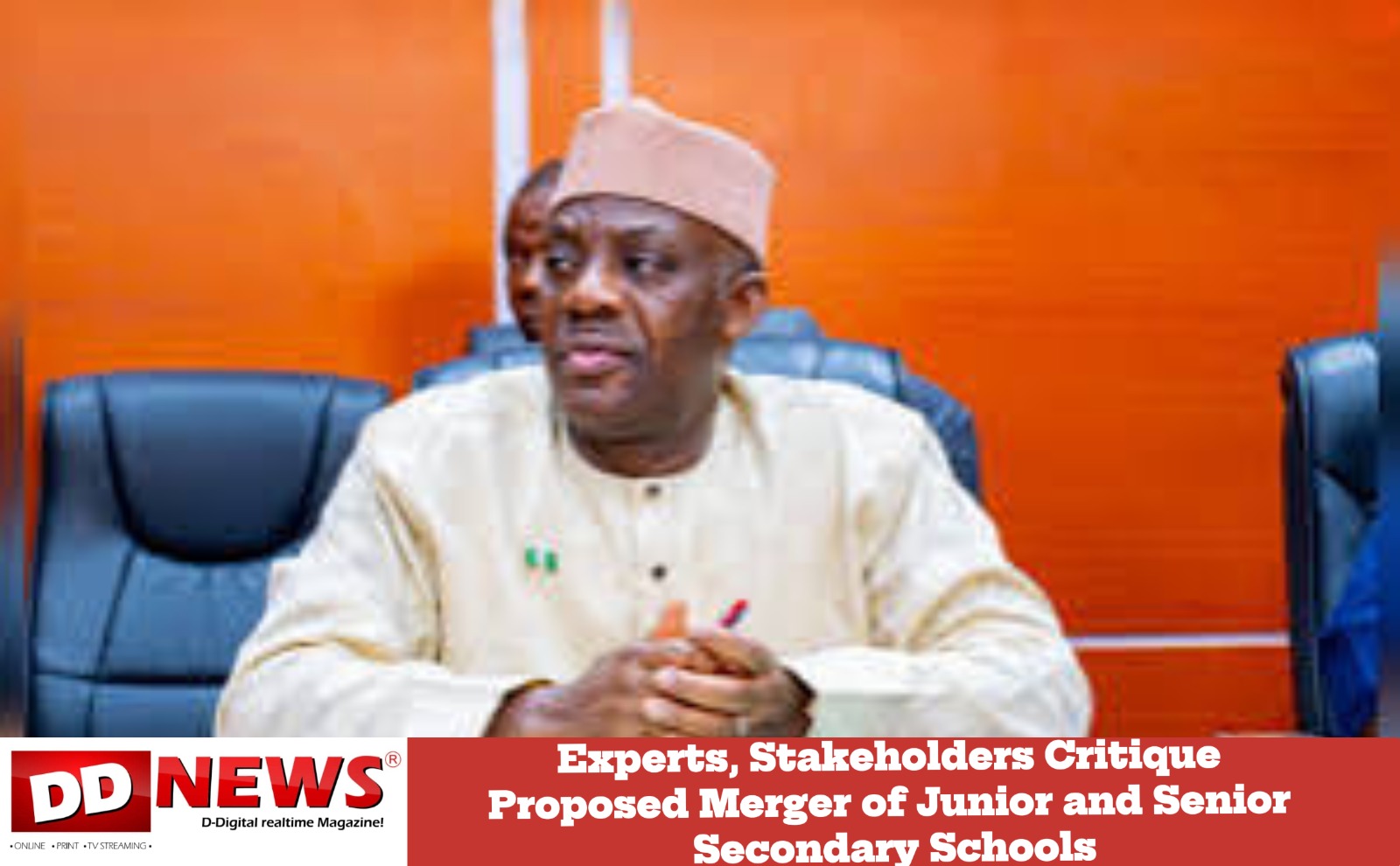
Reactions have continued to trail the announcement by the Minister of Education, Dr Tunji Alausa, that the Federal Government is considering scrapping the Junior Secondary School (JSS) and Senior Secondary School (SSS) system of education in the country.
The Minister spoke at an event in Abuja penultimate Tuesday, saying the government would rather merge JSS and SSS systems into one and allow students to go straight for a six-year education course, unlike when students can transit from JSS to technical colleges if they are not cut for the academic journey.
Follow DDNewsOnline on Facebook For More Breaking News
Also, primary education and the JSS systems form the basic education system under the purview of the Universal Basic Education Commission and States Universal Basic Education Boards.
The comment by Alausa was not new. The idea was mooted by him during the February 2025 Emergency National Council on Education meeting and it did not fly. Some of the reasons the proposal may not work are:
Follow And Like Us On Tiktok
Administrative Hollow-out and Jurisdictional Overlap: Stripping senior secondary schools away from the Ministry of Basic and Secondary Education would leave the ministry hollowed out. Furthermore, because State Universal Basic Education Board (SUBEB) chairmen report directly to state governors rather than federal mandates, forcing a merger introduces unnecessary administrative friction between federal policy and state execution.
Dilution of Supervision and Demotivation of Staff: Operating with distinct Junior Secondary and Senior Secondary principals ensures focused management, closer student monitoring, and better supervision. In a country where the student-to-teacher ratio already grossly exceeds international standards, split leadership keeps schools manageable. Moreover, having separate administrative tracks serves as a vital career motivation and promotion pathway for senior education officers within the Nigerian civil service.
For Breaking News And More Follow Us On Instagram
The government remains hyper-focused on the “quantity” of out-of-school children while completely ignoring the “quality” of the education being offered. We must confront the core failures of our current system:
The Teacher Crisis: Thousands of vacancies remain unfilled in public schools, yet thousands of trained, professional teachers remain unemployed.
Institutional Lethargy: External examination bodies routinely delay the release of Chief Examiners’ reports—sometimes up to 13-15 months after the exams—leaving schools completely blind to systemic student weaknesses.
The Primary-Secondary Geographic Gap: It is structurally unfeasible to enforce a uniform “12-year continuous track” across all regions. While primary schools can exist in isolation within rural villages, secondary schools require specialized labs and diverse subject teachers, meaning they must naturally function as regional hubs for multiple primary feeder schools.
The irony of abandoning the 6-3-3-4 system is that its foundational architecture—12 years of schooling split into distinct developmental tiers—is exactly how the world’s most successful economies operate. From the United States and Canada to Germany, South Africa, Egypt, and Ghana, the segmented 12-year model is the engine of national development.
Check out – Discover How to work and Earn with Dailyhustle
The Minister said about 20 million pupils are unable to transit from primary school to junior secondary school – the reason being that there are not enough secondary schools to accommodate them. There are about 80,000 public primary schools to about 15,000 public secondary schools in the country. The Minister himself made the disclosure recently that the federal government is liaising with state governments to build more secondary schools.
He disclosed that twice earlier this year in Lagos during an interactive session with media practitioners and when he later met with leaders of organized private sector.
Manage Your Business Digitally With D-Degree Digital Hub Today Visit D-Degree Digital Hub

Subscribe To The Best Team In Conservative, Business, Technology, Lifestyle And Digital News Realtime! support@ddnewsonline.com
Children are not dropping out simply due to school structures; they are dropping out because the economic incentive has vanished. When communities see university graduates roaming the streets for years without employment, the value proposition of formal education collapses. Also, the economic challenges confronting many parents have made it difficult for them to be able to keep some of their children and wards in school.
Other factors that are glaring are insecurity, which has led to incessant attacks on schools, religious beliefs, especially in some parts of the country where the girl child is heavily discriminated against amongst others.
Follow Us On Youtube
Instead of restructuring school boundaries and shuffling administrative titles, the Ministry of Education must focus on filling teacher vacancies, improving classroom quality, demanding accountability from examination bodies, aligning education with actual job creation, and ensuring the building of more schools.
The National Council on Education is the highest policy-making body regarding education issues in the country. Moreover, education is on the Concurrent List in the 1999 Constitution as Amended, and that means all the tiers of government – federal, state and even local government areas can decide on what they want education to look like in their areas of jurisdictions.
Share Your Opinion With Us @ddnewsonline
By Ogungbayi Adeyemi S. (Beedee)
Send tips to: adeyemi@ddnewsonline.com
09164987165 / 08168555497
©️ 2026 DD NewsOnline
I pay a visit day-to-day a few blogs and information sites to read posts, but this website presents feature based posts.
xnxx