
Report by Komolafe Barakah
DDNewsonline
LAGOS, Nigeria — 23rd November, 2026.
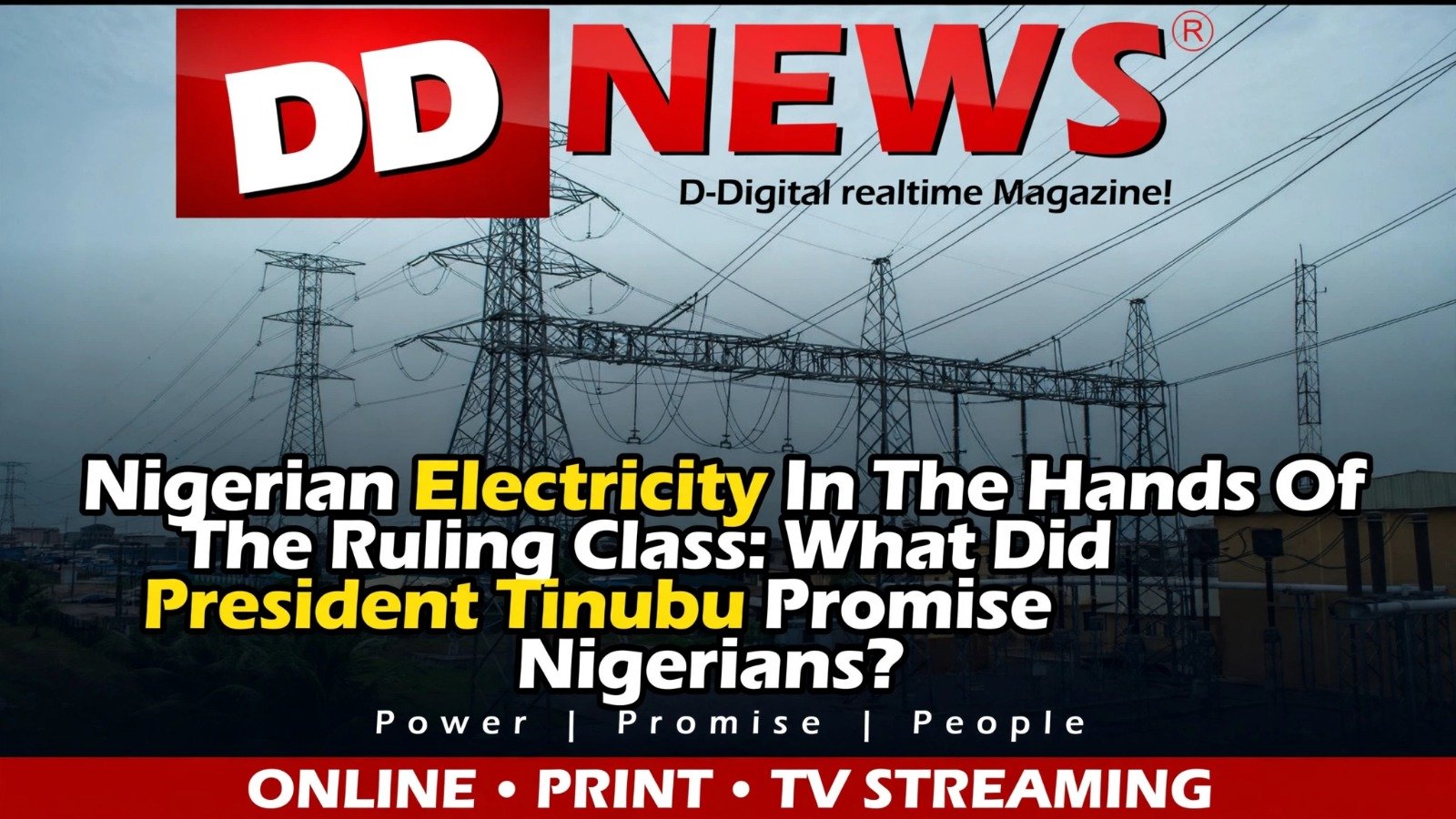
Despite successive government promises to improve electricity supply in Nigeria, millions of citizens and businesses continue to experience unreliable power. With President Bola Tinubu’s administration making commitments to reform the power sector, questions remain about the fulfilment of these promises — and who truly benefits from the country’s electricity system.
What Tinubu Promised
During his 2023 presidential campaign, Bola Tinubu promised Nigerians constant, reliable electricity, nationwide metering to end estimated billing, and sweeping structural reforms across generation, transmission, and distribution.
He pledged that under his leadership, Nigerians would have steady electricity “by all means necessary”.
Follow DDNewsOnline on Facebook For More Breaking News
He told voters not to re-elect him for a second term if he failed to deliver on his power pledge, unless he provided adequate reasons why he could not do so.
What Has Been Done Since May 2023
Since assuming office in May 2023, President Tinubu’s administration has introduced sector decentralization via the Electricity Act 2023, partial subsidy removal through cost-reflective tariffs, legacy debt restructuring, a nationwide metering initiative, and transmission grid upgrades.
Signed on June 9, 2023, the Act repealed the Electric Power Sector Reform Act 2005 and removed electricity from the federal Exclusive Legislative List. It empowers state governments and private entities to generate, transmit, and distribute power, as well as establish state regulatory commissions. States such as Lagos, Enugu, Abia, Ekiti, Oyo, Ondo, Kaduna, and Niger have initiated state-level regulatory frameworks or markets under the Act.
The Federal Government has promised Nigerians stable electricity within a three-to-five-year horizon, a major overhaul of aging grid infrastructure starting in January 2027, and a commitment to avoiding immediate electricity tariff increases while cushioning vulnerable consumers.
Follow And Like Us On Tiktok

Subscribe To The Best Team In Conservative, Business, Technology, Lifestyle And Digital News Realtime! support@ddnewsonline.com
Minister of Power, Joseph Tegbe, assured Nigerians that the country is on track to enjoy stable, uninterrupted electricity within three to five years once critical grid upgrades are completed.
The Reality On The Ground
Under President Tinubu’s administration, Nigeria’s electricity supply has experienced modest peak generation spikes and localized state-level improvements, but overall average grid output remains around 4,000–4,200 megawatts amid recurring grid disturbances, sharply higher tariffs for premium bands, and persistent outages for many consumers.
While peak generation briefly reached roughly 5,800–6,000 megawatts in 2025, everyday supply has hovered close to its 2023 baseline of roughly 4,000 to 4,222 megawatts. According to the Nigerian Electricity Regulatory Commission October 2026 operational factsheet, average hourly generation stood at 4,047 megawatts out of an average available capacity of 4,744 megawatts.
Nigerians continue to experience frequent power outages because legislative reforms have not yet resolved deep structural bottlenecks across the electricity value chain, including gas supply shortages, aging transmission infrastructure, liquidity deficits, and vandalism. Even President Tinubu acknowledged in November 2026 that the State House itself suffers from water and power cuts, warning that repairing 50- to 60-year-old infrastructure takes time rather than a “magical response”.
For Breaking News And More Follow Us On Instagram
Roughly 70% to 80% of Nigeria’s grid power relies on natural gas, yet thermal plants frequently operate far below capacity due to pipeline vandalism, inadequate gas transport infrastructure, and payment disputes with gas suppliers.
Tariffs: Higher Bills, Same Supply
Electricity tariff increases — most notably the April 2024 hike that raised Band A rates by over 230% (from roughly ₦66–₦68/kWh to ₦206.8–₦225/kWh) — have sharply increased living and operating costs, squeezed disposable incomes and profit margins, and accelerated the shift toward solar energy.
According to research by the Nigerian Institute of Social and Economic Research (NISER), 79% of surveyed households reported that the revised tariffs are unaffordable — including 88.7% in Lagos and 72.9% in Kano — with energy bills taking up a disproportionate share of monthly household budgets.
What Nigerians Think
Public opinion in Nigeria regarding the government’s performance in the power sector is overwhelmingly negative, marked by deep skepticism over unfulfilled campaign promises, frustration with high tariffs amid unreliable supply, and a growing shift toward self-generation.
Check out – Discover How to work and Earn with Dailyhustle
According to a 38-country survey conducted between 2024 and 2025 and published by Afrobarometer on September 22, 2026:
Only 12% of Nigerian respondents said the government is performing “fairly well” or “very well” in providing a reliable supply of electricity — tying Nigeria with Chad for the lowest approval rating among all 38 surveyed African nations (compared to a continental average of 45%).
Debt And The Way Forward
To ease sector liquidity bottlenecks, the administration negotiated roughly ₦6 trillion in verified historical debts owed to generation companies and gas suppliers down to ₦3.3–₦3.48 trillion. According to Minister of Power Joseph Tegbe on November 23, 2026, the government had paid ₦1.23 trillion over 18 months toward clearing the balance.
To deliver both reliable and affordable electricity, energy analysts, industry stakeholders, and policy institutions suggest that the Federal Government must stabilize gas supply and grid infrastructure while enforcing financial discipline, universal metering, and decentralized energy expansion.
Ultimately, improving Nigeria’s electricity sector requires more than government promises and policy reforms. The Federal Government must ensure effective implementation, accountability and transparency to provide Nigerians with stable, affordable and reliable electricity. The success of Tinubu’s administration will partly depend on its ability to turn its electricity promises into visible improvements in citizens’ daily lives.
Follow Us On Youtube
Report by Komolafe Barakah, IT student, Federal Polytechnic, Ilaro, studying Mass Communication.
| DDNewsonline | adeyemi@ddnewsonline.com | 08168555497